
Is your organization flying blind about whether your supplier prices for supplies and services are competitive or not? In this article, we’ll outline strategies to take back your purchasing power with suppliers using various quoting and benchmark strategies.
What is Benchmarking?
Benchmarking is the practice of comparing something (process, data sets) against a standard or market leader that performs the same processes or have the same data sets. The objective of benchmarking is to identify opportunities for organizational improvement, including cost reduction and profit improvement.
Why You Should Use Price Benchmarking
Research tells us that organizations that do not have centralized purchasing functions can cost their organizations 25% on average by overpaying for supplies and services.
A request for quote (RFQ) is the most reliable method to gather current market pricing for supplies and services. An RFQ is the best way to obtain competitive market pricing data and reveals “truth in the marketplace”.
Price Benchmarks and Where to Find Them
Pricing benchmarks are a collection of pricing data related to those items that might represent the best and worst of pricing for those items in the marketplace.
Using a shop towel example — obtaining benchmarks on supplier pricing might look something like this:
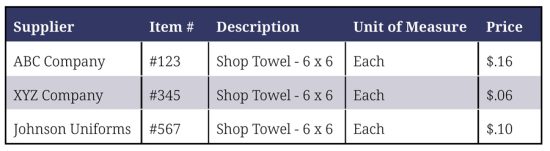
This would be a good example of benchmarking for both services and supplies. With a range of prices for the same item, you’re comparing apples to apples and will arrive at the best, most competitive market price.
Your target pricing is now $.06 for a shop towel based on these benchmarks, and the high-priced outlier is $.16. Negotiating a deal for $.14 for a shop towel might be a “win” to some people, but you’re still paying far too much for the product based on benchmark data. The unfortunate reality is that this situation is what happens most often: negotiated pricing that falls short of the mark, without the power of benchmark data behind it, will result in overpaying for the item.
Where to Obtain Price Benchmarks
Obtaining benchmarks takes some time, but the approaches listed below can speed up the process.
- Request for Quotes: The most efficient way to determine the true price in the marketplace is to develop a well-designed RFQ and target 3 to 4 qualified suppliers for quote participation.
- Internal Benchmarking: Compare prices for services and supplies within your own dealership group to obtain “target pricing” by obtaining other supplier invoices.
- External Benchmarking: Benchmarks for supplies and services from members of your networking groups or friends in the industry. But make sure to review a broad range of items rather than just a few to make the time and investment worthwhile.
- Purchased Data: There are some sites where data can be purchased to accomplish benchmarking, but might not be available in all expense categories.
- Supplier Websites: Some suppliers publish discounted or regular prices, including discounts, on their websites, which can serve as useful benchmarks.
- State Associations: Your state association might be a good source of benchmarks and price offerings in expense categories, but keep in mind that their pricing usually reflects a rebate paid back to the association, which might average 5% of the purchase price.
What to do After Benchmarking
After you complete your quote or obtain your benchmarks, there’s still work to be done:
- Price Locks: When you obtain the right benchmarks and prepare to renegotiate with your supplier, be sure to “lock” the pricing and business terms for the life of the renewed contract or length of the pricing agreement.
- Broad Range of Supplies and Services: Renegotiating supply and service prices for a broad group of items you use will effectively put a dent in costs and improve your profitability. If you only renegotiate a few items or categories, the savings won’t be enough to reduce overall costs.
Can’t Find Benchmarking Data? We’re Here to Help!
Developing an effective strategy to drive down costs and improve profitability is to utilize the time honored RFQ or price benchmarks. Using an RFQ is the best method to drive down prices and supplier costs. An effective RFQ allows you to negotiate with confidence and embolden you to pursue changing suppliers if your incumbent supplier is not competitive. Benchmarking will still take time, but StrategicSource can make it simple. Our results produce an average 25% cost reduction by developing a sourcing plan, executing the plan which includes RFQ’s, benchmarking and negotiation. If you’re planning to undertake this effort to get your spend management function set up and running correctly, you don’t have to go it alone.
StrategicSource’s Profit Improvement Program helps you identify areas for long-term improvement.